


We see two of the most asked questions travelers ask when planning a sightseeing day in a city: ‘Should I choose a hop-on hop-off bus or public transport in (city)?’ and ‘is hop-on hop-off bus worth it in (city)?’ Today we focus on the first question to be discussed in detail. So, this blog is going to be a detailed comparison of hop-on hop-off vs public transport in major cities. By the end, you’ll know which option is more convenient, affordable, and efficient.

Hop-On Hop-Off vs Public Transport: Key Differences
Before comparing the two options with real examples in different cities, it’s important to understand how these work.
Hop-on hop-off buses are essentially sightseeing tours onboard a bus. These double-decker buses follow fixed routes that pass major attractions. Travelers can hop off at any stop, explore the area, and board the next bus using the same ticket.
Your ticket comes with unlimited rides within different time periods like 1-day, 24- or 48- or 72-hour, and also includes multilingual audio commentary explaining the landmarks and history of the city. This means transportation and sightseeing happen at the same time.
Public transport works differently. It includes metros, trams, and city buses used mainly by residents. These systems are designed to move people efficiently from one place to another and in some of the cities you’ll find these options better from anything else.
But what you’ve to do to use public transport is to study routes, change lines, and navigate stations, which can be confusing in an unfamiliar city.
In simple words:
- Hop-on hop-off buses focus on sightseeing convenience
- Public transport focuses on speed and affordability
[product_card="5125, 14002, 27608?]
Cost Comparison: Hop-On Hop-Off vs Public Transport
When we plan a trip, the second factor comes after choosing attractions, is the price. Even for some travelers, budget is the main factor while planning a trip. Similarly, budget is also the main criteria travelers consider when choosing between these options: hop-on hop-off bus and public transport.
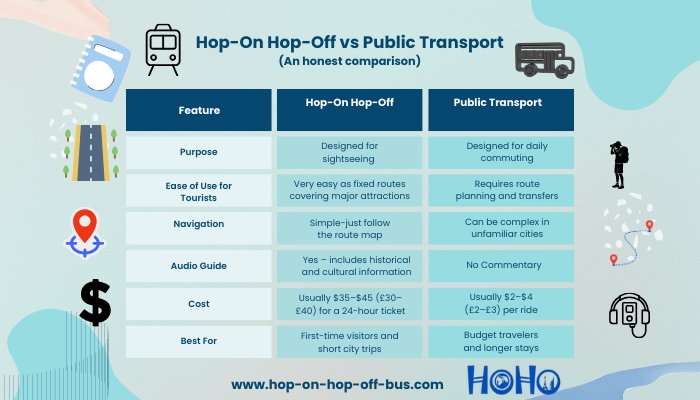
A typical hop-on hop-off bus ticket in most European cities costs around $35–$45 (£30–£40) for a 24-hour period. This usually includes unlimited rides on the sightseeing routes and access to audio commentary in multiple languages.
Public transport is generally cheaper. A single metro or bus ticket in many cities costs $2–$4 (£2–£3). However, tourists often need multiple rides throughout the day. They may also need to buy day passes or zone tickets depending on how far they travel.
If you want to visit many attractions in one day, the total cost of multiple metro or bus trips can sometimes add up. That’s why the best option often depends on whether your goal is sightseeing or simply moving from point A to point B.
Now, we will explain the comparisons in detail with examples of specific cities so that you can understand the whole scenario better.

Example: Getting Around London
London is an ideal city to compare hop-on-hop-off buses with public transport. Hop-on hop-off buses in London typically cruise past major landmarks such as Big Ben, Buckingham Palace, the Tower of London, and the London Eye. Additionally, London is a place whose history is essential to know, and the audio commentary included with London bus tour tickets explains the city’s history as you travel between attractions. However, London also has one of the most efficient metro systems in the world: the London Underground. Using the Tube is usually faster for traveling long distances. But many tourists find themselves changing lines several times or walking between stations to reach attractions.
According to experienced travelers, hop-on hop-off buses are especially useful if you only have one day in London and want to see the highlights quickly.

Example: Sightseeing in Barcelona
Barcelona is known for its modern public transport system, including an efficient metro network. However, the city’s attractions, such as Sagrada Familia, Park Güell, Casa Batlló, and La Rambla, are spread across different neighborhoods. People sometimes choose Barcelona bus tours because they connect these landmarks on two sightseeing routes covering historic and coastal areas. In cities where attractions are far apart, many tourists feel the buses can be worth it.

Example: Exploring Paris
Paris offers another interesting comparison. Hop-on hop-off buses stop near attractions like the Eiffel Tower, Louvre Museum, Notre Dame, and Champs-Élysées. Because the buses run above ground, travelers can enjoy views of the city while moving between landmarks. Paris also has an extensive metro network. It is often faster than buses, but you travel underground and miss the scenery.
However, people prefer taking the hop-on hop-off bus in Paris when they are tired or simply want to sit and enjoy views of the city without navigating metro routes.

Example: Visiting Rome
Rome is a city where sightseeing and transportation often overlap. Hop-on hop-off buses connect landmarks such as the Colosseum, Vatican City, Roman Forum, and Piazza Venezia. Since many attractions are spread across historic districts, these buses provide a straightforward sightseeing route.
Rome’s metro system is smaller than those in cities like London or Paris, and many attractions are not directly connected by metro lines. So, it would be great to choose the double-decker bus tour in Rome if you’re traveling for the first time.

Example: Getting Around Dublin
Dublin is relatively compact, which means many attractions are within walking distance. However, hop-on hop-off buses are still popular among first-time visitors. Most hop-on hop-off routes pass major attractions such as Trinity College, Guinness Storehouse, Dublin Castle, and St. Patrick’s Cathedral. The buses also provide commentary about the city’s literary and cultural history.
Public transport in Dublin mainly consists of city buses and trams (Luas). While they work well for locals, the routes are not specifically designed for sightseeing. For travelers visiting the city for a short time, hop-on hop-off buses in Dublin often make it easier to see the city’s highlights without figuring out multiple bus routes.

Example: Exploring Edinburgh
Edinburgh is smaller than many European capitals, but its historic layout makes sightseeing unique. Hop-on hop-off buses usually stop at places such as Edinburgh Castle, the Royal Mile, and Holyrood Palace. Local buses work well for residents, but the routes are designed for commuting rather than sightseeing.
If you’re visiting Edinburgh for only a day or two, you can choose hop-on hop-off buses as they provide a simple way to see the city’s historic highlights without complicated planning.

Example: Sightseeing in Tokyo
Tokyo has one of the most efficient public transport systems in the world. The Tokyo Metro and JR train lines connect almost every part of the city quickly and reliably. However, Tokyo can feel overwhelming for first-time visitors because the rail network is so extensive. Travelers often need to transfer between several lines to reach popular areas.
Hop-on hop-off buses in Tokyo usually connect places such as Asakusa, Tokyo Skytree, Shinjuku, and the Tokyo Tower. These routes allow travelers to see parts of the city above ground while moving between major sightseeing areas. Moreover, it is also very useful during peak season such as cherry blossom seasons in Japan when you need to move around the city without stress and crowd.
If you’re unfamiliar with Tokyo’s complex train system and don’t want to delve into it, the sightseeing bus can provide a simpler way to explore the city on the first day.

Example: Exploring Seville
Seville is one of Spain’s most walkable cities, but hop-on hop-off buses are still commonly used by tourists. The sightseeing routes usually connect major landmarks such as Seville Cathedral, Alcázar of Seville, Plaza de España, and Torre del Oro.
Public transport in Seville includes buses and a metro line, but many of the historic attractions are located within the old city center where metro coverage is limited.
Because of this, hop-on hop-off buses often provide a convenient way for travelers to move between key landmarks while learning about the city’s history.

Example: Getting Around Oslo
Oslo has an efficient public transport system that includes trams, buses, ferries, and metro lines. Many travelers use these options to move around the city quickly. However, hop-on hop-off buses remain popular for sightseeing because they connect attractions such as the Viking Ship Museum, Oslo Opera House, Vigeland Sculpture Park, and Akershus Fortress. The sightseeing routes allow visitors to cover several cultural landmarks in one trip while enjoying views of the harbor and waterfront.
The hop-on hop-off buses can offer a simple introduction to the city’s main attractions especially for travelers visiting Oslo for a short stay.

Smart Tips for Using Hop-On Hop-Off Buses (From Real Travelers)
Hop-on hop-off buses work best when used strategically. Many experienced travelers use them in creative ways to get more value from their ticket. So, we have jotted down every user’s point of view here to help you for better planning.
Use the Bus to Map Your Day
Some travelers treat the first ride as a planning tool rather than transportation. They shared that when they first arrive in a city, they ride the full route once and drop Google Maps pins on places that look interesting. Later, they return to those spots and explore them properly.
This approach works especially well in cities like Paris or London, where attractions and neighborhoods are spread out.
Ride the Entire Loop Once Before Getting Off
Another common tip from experienced travelers is to complete one full loop before hopping off. This helps you to understand the city layout, identify the stops closest to attractions, and decide which places are worth visiting. It essentially becomes a city orientation tour.
Use It When You’re Tired but Still Want to See the City
Several travelers say hop-on hop-off buses are perfect for low-energy sightseeing days. Instead of walking all day or navigating metro stations, you can sit on the upper deck and still see landmarks while resting. This is especially useful toward the end of a trip when travel fatigue kicks in.
Treat It Like a Moving City Tour
Many people make the mistake of using hop-on hop-off buses only as transportation. But experienced travelers say the real value comes from listening to the audio guide and treating it like a guided tour. The commentary often shares historical context, stories, and facts you would miss when using regular buses or metro systems.
Use It for Hard-to-Navigate Cities
Travelers often say hop-on hop-off buses are most useful in cities where public transport doesn’t connect attractions easily.
For example:
- Rome, where many landmarks are far from metro stations
- Edinburgh, where sightseeing areas are concentrated around historic streets
- Barcelona, where attractions are spread across multiple neighborhoods
In these cases, the sightseeing routes connect many major landmarks in a single loop.
Check the Last Bus Time
One mistake travelers mention frequently is missing the final bus of the day. Unlike public transport, hop-on hop-off buses usually run only until late afternoon or early evening. If you hop off too late in the day, you might need to return using public transport. Planning around the last departure time helps avoid this issue.
Use the Bus for Scenic Routes
Many travelers say they use hop-on hop-off buses for routes that are pleasant to see above ground.
For example:
- crossing the Thames in London
- driving along the Seine in Paris
- passing through historic areas of Rome
Taking the bus allows you to enjoy the views rather than traveling underground on the metro.

Common Mistakes Tourists Make When Choosing Transport
Choosing between hop-on hop-off buses and public transport can be confusing, especially in large cities. Many travelers end up wasting time or money simply because they misunderstand how each option works.
Here are some common mistakes tourists make when deciding how to get around a city.
Choosing Public Transport Without Understanding the Network
Many travelers assume public transport will always be the best option because it is cheaper. However, in cities like Rome or Barcelona, metro lines don’t always connect directly to the main attractions. Tourists often need to switch between buses, metro lines, or walk long distances between stations. Without understanding the network in advance, travelers can spend a lot of time navigating routes instead of enjoying the city.
Using Hop-On Hop-Off Buses Only for Transportation
Some tourists treat hop-on hop-off buses like regular city buses. But the real value of these buses is the sightseeing experience and commentary. The routes are designed to pass major landmarks, and the audio guides provide historical context about what you’re seeing. Travelers who simply ride from stop to stop without listening to the commentary often miss half of the experience.
Not Considering Traffic Conditions
Hop-on hop-off buses travel on regular city roads, which means they can be affected by traffic. In busy cities such as London or Paris, buses may move slowly during peak hours. If you are trying to reach a specific attraction quickly, the metro may be the faster option. Understanding when to use each option can help travelers avoid delays.
Trying to Visit Too Many Attractions in One Day
Another common mistake is trying to use transport options to cover too many sights in a short time. Hop-on hop-off buses make it easy to move between attractions, but some travelers underestimate how long it takes to explore each stop. Instead of enjoying the city, they end up rushing from one location to another. A better approach is to choose a few key stops and explore them properly.
Ignoring the Geography of the City
Every city is different, and the best transport option often depends on the layout of the destination.
For example:
- Paris and Tokyo have extensive metro systems that make public transport very efficient.
- Edinburgh and Seville have compact historic centers where sightseeing buses can provide a convenient overview.
- Cities like Dublin or Oslo are relatively small, where a mix of walking and hop-on hop-off buses works well.
Understanding the city’s geography helps travelers choose the right transport option for their trip.
Assuming One Option Is Always Better
The biggest mistake travelers make is assuming that either hop-on hop-off buses or public transport is always better. In reality, experienced travelers often use both during their trip. For example, they might use a hop-on hop-off bus on the first day to see the main sights and then rely on public transport for the rest of their stay. Combining both options can often provide the best travel experience.
TL;DR (Too Long; Didn’t Read)
Hop-on hop-off buses are designed for sightseeing. They are convenient for first-time visitors who want to see major landmarks easily. On the other hand, public transport is usually cheaper and faster, especially in cities with extensive metro systems. For short trips in cities like London, Paris, Rome, Barcelona, or Edinburgh, many travelers find hop-on hop-off buses helpful for getting an overview of the city. For longer stays, public transport often becomes the more practical option.